
Is Your Pest Monitoring System Sensitive Enough?
Pest monitoring is supposed to provide an early warning.
The basic idea behind monitoring is simple: identify a change in pest activity early enough that something can be done before that activity develops into a significant problem. But there is an important question that is often overlooked: How much evidence must exist before your monitoring system can detect it? This is a question of detection resolution.
What Is Detection Resolution?
Detection resolution describes the ability of a monitoring method or device to identify small changes in the biological state of a pest population. This matters because the earliest evidence of pest activity can be extremely subtle.
A single mouse dropping discovered during an inspection, for example, may indicate the presence of a mouse long before that animal happens to encounter and interact with a permanently placed mechanical trap.
Both methods monitor the same underlying condition, the presence and activity of mice, but they may not detect that condition at the same point. In other words, different monitoring methods can provide different levels of detection resolution.
Detection Is Not the Same as Presence
One of the challenges in pest monitoring is recognizing that a lack of detections does not necessarily mean a lack of pest activity. A monitoring device can only report what it can detect.
Consider a mechanical rodent trap. For the trap to produce a positive monitoring result, several things generally must happen. A rodent must be present, move into the area being monitored, encounter the device, interact with it appropriately, and ultimately trigger it. Until that sequence occurs, the monitoring result may remain zero, even though rodent activity is occurring elsewhere in the facility.
Visual inspection operates differently. Rather than depending upon interaction with a specific device, an inspector may look for multiple forms of evidence, including droppings, gnawing, nesting material, rub marks, food damage, or live sightings.
The two approaches are therefore sampling pest activity differently.
What We Observed in the Field
We recently compared these differences during monitoring of a warehouse over approximately seven months.
One monitoring method consisted of uniformly spaced multiple-capture mechanical rodent traps, a deployment strategy commonly used in commercial pest management programs.
The second method consisted of visual inspection of the warehouse racking for evidence associated with mouse activity.
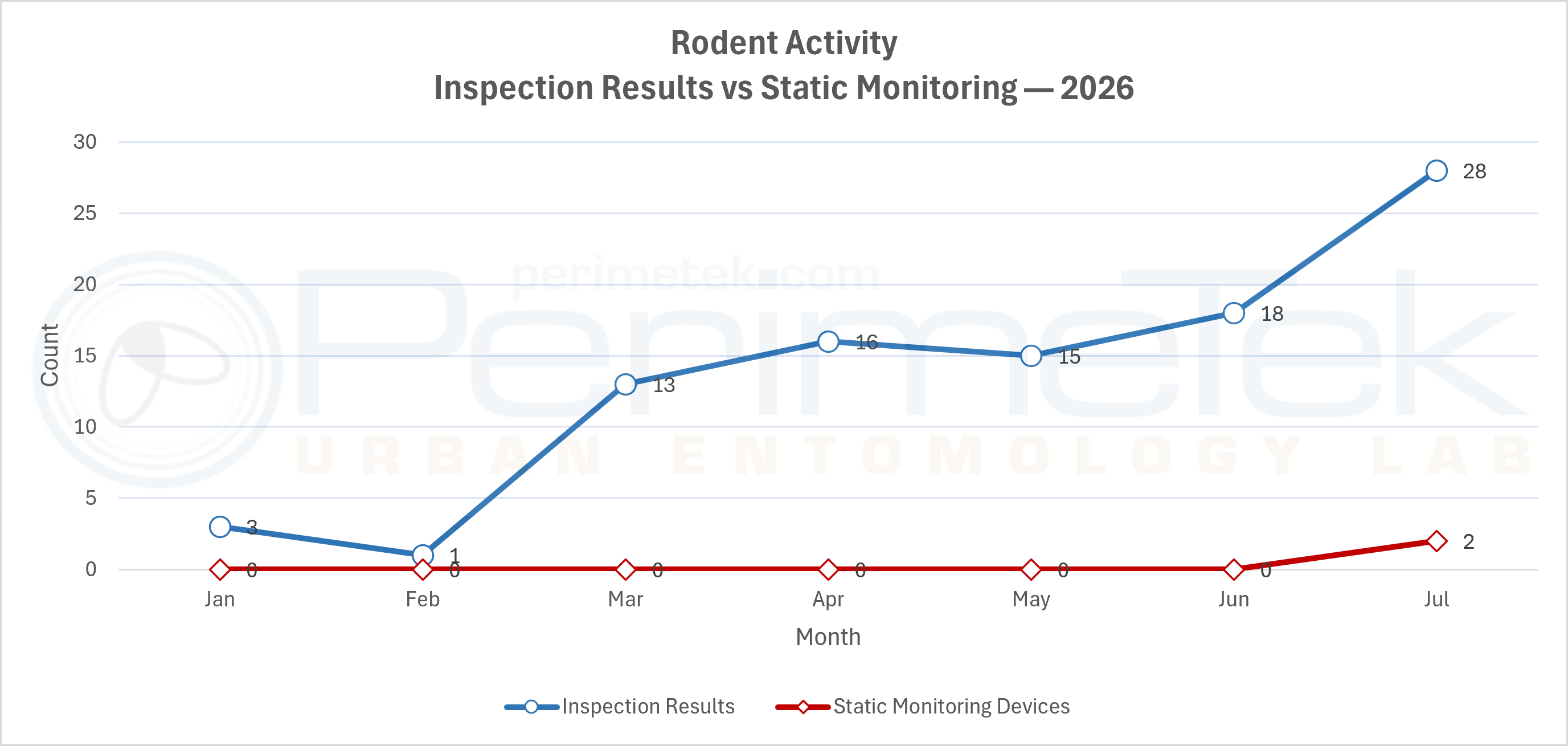
For most of the monitoring period, the mechanical devices reported no captures. Two rodents were eventually captured toward the end of month seven. Visual inspection told a different story. Evidence began increasing during month three. Activity then continued to be observed during subsequent months before increasing substantially during month seven.
The mechanical devices eventually detected the problem, but only after considerably more evidence had accumulated within the environment. However, this does not mean that visual inspection is universally better than mechanical monitoring devices. It means the two methods have different detection resolutions.
Matching Detection Resolution to Risk
This distinction becomes particularly important when designing a monitoring program around risk.
In an environment where occasional pest activity represents relatively little operational or product risk, a lower-resolution monitoring method may be entirely appropriate.Mechanical devices can provide economical, repeatable monitoring over large areas with relatively little labor.
But consider an area where the presence of even a single pest could have serious consequences. Waiting for that pest to encounter a monitoring device may not provide sufficient detection resolution. A more sensitive monitoring approach, or more often, a combination of methods, may be warranted.
This suggests an important principle for monitoring program design: The detection resolution of the monitoring system should be proportional to the consequences of failing to detect the pest. As the consequences of an undetected pest event increase, the monitoring system should generally become capable of detecting increasingly subtle evidence.
There is a Cost to Resolution
Detailed visual inspection can provide considerably more information about current conditions,but it requires skilled labor and time. Permanently placed mechanical devices may provide less detailed information about low-level activity, but they can monitor large areas economically and continuously.
That may mean using economical monitoring devices across lower-risk portions of a facility while applying more sensitive inspection or monitoring methods in critical areas. It may also mean combining methods so that their respective strengths compensate for one another's limitations.